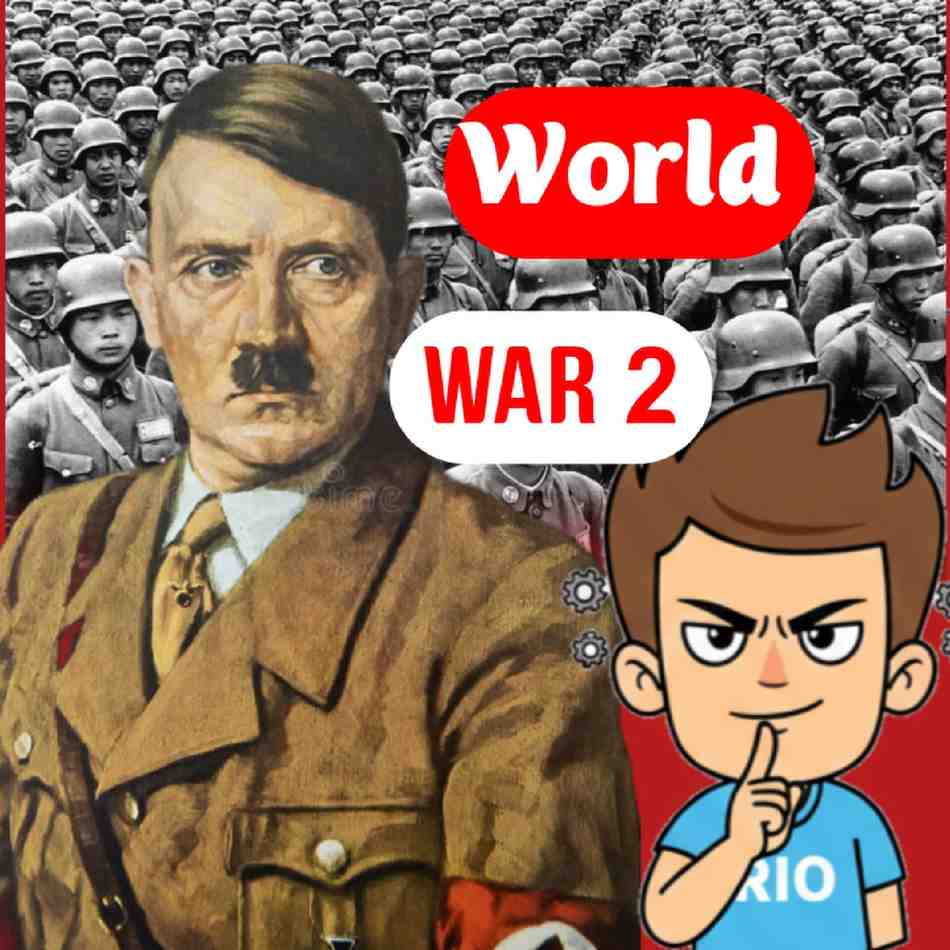
World War 2 was one of the most horrific and destructive events in history, claiming millions of lives and changing the world forever. The war began on September 1, 1939, when Germany invaded Poland. But did you know that the roots of this war lie in events that occurred much earlier? In this article, we will discuss the real causes of the start of World War 2, such as the Treaty of Versailles, the rise of Adolf Hitler, the aggressive policies of Nazi Germany, and the initial invasions. This information is based on historical facts.
The Treaty of Versailles: The First Root of the War
World War I ended in 1918, followed by the Treaty of Versailles in 1919. This treaty is considered one of the most hated treaties in the world, as it placed all the blame on Germany. Article 231 of the treaty contained the “war guilt clause,” which stated that the entire war was Germany’s fault. Germany was fined $33 billion, which is equivalent to approximately $270 billion today. Germany had to pay this amount in installments, and the last installment was paid in 2010.
This treaty devastated the German economy. In the 1920s, hyperinflation occurred, meaning that inflation increased so much that the prices of goods skyrocketed. For example, in 1922, a loaf of bread cost 160 marks, but in 1923, it cost 200 billion marks. People would go to the market with wheelbarrows full of money, but still couldn’t buy anything. Unemployment increased, and people were on the verge of starvation. All of this created anger and resentment in Germany, which later led to the rise of a leader like Hitler.
Historically, the Treaty of Versailles forced Germany to limit its military. Germany was only allowed to have an army of 100,000 soldiers, and no air force or large navy. However, Germany began violating these rules, which was the first step towards war.
The Rise of Adolf Hitler: Propaganda and the Politics of Hatred
In 1923, Hitler staged an unsuccessful coup, known as the Beer Hall Putsch. Although it failed, it increased the popularity of the Nazi Party. While in prison, Hitler wrote the book ‘Mein Kampf,’ in which he outlined his ideology. The Great Depression of 1929 further devastated Germany. By 1933, six million people were unemployed. Taking advantage of this situation, Hitler seized power and made himself a dictator.
Hitler’s ideology was based on the superiority of the Aryan race. He considered Germans to be Aryans and claimed they needed “Lebensraum,” or living space. He considered Slavs and Jews to be inferior. He created the theory of “Judeo-Bolshevism,” which claimed that Jews were responsible for the 1917 Russian Revolution and that they were communists. Hitler used propaganda to incite the people, blaming Jews, socialists, and minorities for Germany’s defeat.
Hitler’s propaganda machine was so powerful that it took control of the entire country. He used radio, posters, and rallies. Historical facts show that the Nazi Party won the elections in 1933, but after that, Hitler had the parliament building set on fire and seized power by declaring a state of emergency. All of this was laying the foundation for World War II.
Germany’s Initial Aggression: Violation of Treaties
In 1935, Germany revealed its air force, a direct violation of the Treaty of Versailles. Britain signed the Anglo-German Naval Agreement, recognizing Germany’s navy. France built the Maginot Line, a series of strong fortifications along the German border, but these were purely defensive.
In 1938, Hitler annexed Austria, an event known as the Anschluss. This was achieved without bloodshed, as Hitler used propaganda and infiltration tactics. He forced the Austrian Chancellor to resign and installed a Nazi minister in his place. The Austrian people also desired German unification, so there was no resistance.
Then came the Munich Agreement in 1938. In this agreement, British Prime Minister Neville Chamberlain ceded the Sudetenland region of Czechoslovakia to Germany, where most of the population was German-speaking. Chamberlain believed this would avert war, but Hitler violated the agreement and occupied all of Czechoslovakia in 1939. The country was divided into two parts: a German territory and a Slovak Republic, which was a German puppet state.
These events demonstrate that the policy of appeasement failed. Instead of stopping Hitler, Britain and France allowed him to become even stronger. Historically, the Munich Agreement is still considered a symbol of a grave mistake.
Invasion of Poland: The Official Start of the War
In 1939, Hitler signed a non-aggression pact with the Soviet Union, which included a secret agreement to partition Poland. On September 1, 1939, Germany invaded Poland. Approximately one million soldiers employed the Blitzkrieg strategy, a “lightning war” involving rapid tank attacks, Luftwaffe (air force) bombing, and infantry support.
German soldiers were given a drug called Pervitin, which was crystal methamphetamine. This allowed them to fight continuously without feeling fatigue. The Polish army was outdated, fighting on horseback, while Germany possessed modern weaponry. Poland was defeated in just one week.
Britain and France issued an ultimatum, but Germany ignored it. On September 3, both countries declared war on Germany. However, there were no major attacks initially; this period is known as the “Phoney War.” Poland received no assistance and was divided between Germany and the Soviet Union. The Soviet Union occupied eastern Poland.
Historical fact: More than 30 countries were involved in this conflict, which lasted until 1945. The death toll was between 70 and 80 million.
Further Invasions: Norway, Denmark, and France
In November 1939, the Soviet Union invaded Finland because it wanted territory near Leningrad. Finland fought bravely but lost 11% of its territory in the Moscow Peace Treaty of 1940. In April 1940, Germany invaded Norway and Denmark. Both countries quickly fell to the Blitzkrieg.
In May 1940, Germany invaded France, Belgium, the Netherlands, and Luxembourg. France’s Maginot Line was strong, but Germany attacked through the Ardennes forest, a strategic maneuver. Group C attacked the Maginot Line, but the real attack came through the Ardennes. The French army was surrounded.
In June 1940, 350,000 Allied soldiers were evacuated from Dunkirk in an operation called Operation Dynamo. This was the largest evacuation in history. France surrendered on June 22, 1940. Italy, allied with Germany through the “Pact of Steel,” joined the war.
By July 1940, Germany had occupied Austria, Poland, Denmark, Norway, Belgium, Luxembourg, the Netherlands, and France. Britain stood alone, with Winston Churchill becoming Prime Minister. Chamberlain had resigned.
The Impact and Lessons of World War 2
World War II devastated the world. Cities were destroyed, and economies ruined. But it taught us how dangerous dictatorship, hatred, and appeasement are. Hitler’s propaganda tactics are still seen today on social media, where fake news spreads.
Historically, the United Nations was formed after the war, and human rights were emphasized. But even today, there are conflicts in the world, such as the Ukraine-Russia war, which are reminiscent of past events.
At the beginning of the war, the Blitzkrieg demonstrated the importance of technology and strategy. The use of drugs like Pervitin is a reminder of today’s drug problems. The Dunkirk evacuation was depicted in Christopher Nolan’s film “Dunkirk,” which is based on real events.
The Depth of Nazi Ideology
Hitler’s Aryan supremacy was not just talk; he murdered millions of Jews in the Holocaust. But it all started with propaganda. Laws against Jews were enacted in Germany from 1933 onwards, such as the Nuremberg Laws, which deprived them of their civil rights.
The Soviet Union’s pact was temporary; In 1941, Hitler launched Operation Barbarossa, attacking the Soviet Union, which proved to be a turning point in the war. However, in the initial stages, the Soviets had gained territory from Poland and Finland.
Britain’s Role at the Beginning of the War
Britain made a mistake with Chamberlain’s appeasement policy, but Churchill united the people with his “We shall fight on the beaches” speech. Britain stood alone initially, but later joined forces with the United States and the Soviet Union to achieve victory.
Rio Opinion
World War II began with the Treaty of Versailles, which led to the rise of Hitler and his subsequent invasions. This war engulfed more than 30 countries, and its effects are still felt today. We must emphasize peace, democracy, and truth. If we do not learn from history, the mistakes can be repeated.