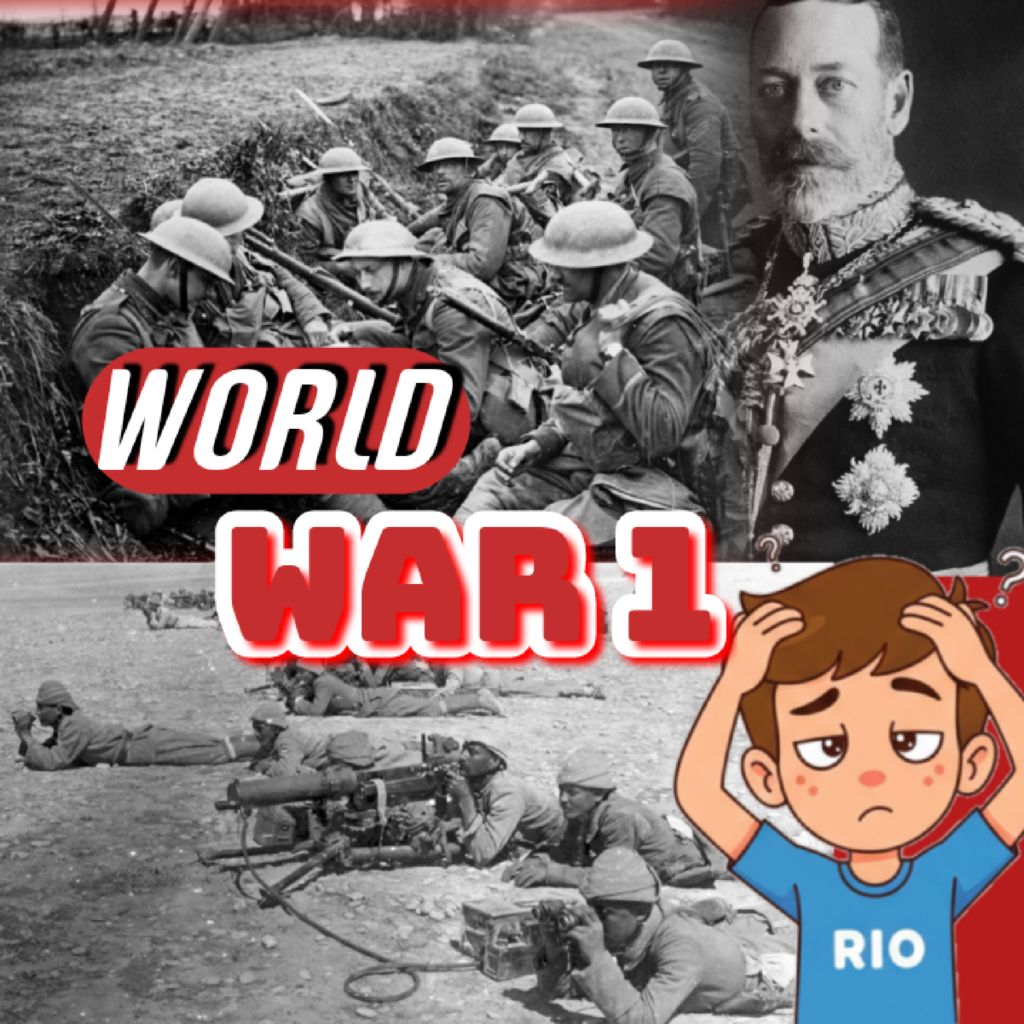
World War 1 was one of the most destructive events in human history. Lasting from July 28, 1914, to November 11, 1918, this war reshaped the geography and history of the entire world. We often read in books that the assassination of a prince started the war, but was the reality really that simple?
The truth is, that assassination was merely a spark; the powder keg had been accumulating for decades. Let’s understand in detail how the world moved towards this great catastrophe.
An Assassination and the Beginning of the War (Immediate Cause)
On June 28, 1914, Archduke Franz Ferdinand, heir to the Austro-Hungarian throne, was on a visit to Sarajevo, the capital of Bosnia, with his wife Sophie. During this visit, a 19-year-old Serbian student, Gavrilo Princip, shot and killed them.
Gavrilo was part of a revolutionary group called ‘Young Bosnia,’ which wanted Bosnia to gain independence from Austria and unite with Serbia to form a larger ‘Yugoslavia’ (a South Slavic country). This assassination enraged the Austrian emperor, and he decided to attack Serbia.
Four Underlying Causes of the War: The ‘M.A.I.N‘ Formula
Historians believe that there were four main reasons behind the outbreak of World War I, which are referred to as ‘M.A.I.N’:
(M) Militarism
At the beginning of the 20th century, all the major European countries, such as Britain, Germany, and France, were engaged in a race to increase their military power. Between 1870 and 1914, these countries quadrupled their military spending. Every country had modern weapons and a large army ready; they just needed an excuse to fight.
(A) Alliances – Secret Treaties and Alliances
During that period, countries made secret agreements with each other. For example:
• Triple Alliance: Germany, Austria-Hungary, and Italy were allied.
• Triple Entente: Britain, France, and Russia were allied.
The rule was that if one country was attacked, its allies would also join the war. This “chain reaction” is what turned a small conflict into a world war.
(I) Imperialism – Imperialism
Powerful countries wanted to conquer weaker parts of the world (like Africa and Asia) and exploit their resources. Britain and France already ruled over vast territories, which made countries like Germany and Austria envious. They were willing to go to any lengths to expand their empires.
(N) Nationalism – Extreme Nationalism
At that time, nationalism didn’t just mean loving one’s own country, but also looking down on other countries. People were led to believe that fighting a war was an act of bravery. The media and newspapers also played a significant role in spreading hatred.
Europe in 1914: A Game of Kings
There is a big difference between today’s Europe and Europe in 1914. At that time, democracy existed in very few countries.
• Austro-Hungarian Empire: This was made up of several countries, including present-day Austria, Hungary, the Czech Republic, and Bosnia.
• Ottoman Empire: Present-day Turkey and a large surrounding area.
• Russia: It was ruled by Tsar Nicholas II. Interestingly, King George V of Britain, Kaiser Wilhelm of Germany, and Tsar Nicholas of Russia were all cousins. This war was, in a way, also an “ego clash” between kings of the same family.
The Plight of the Common People and Soldiers in the War
Did the common people want this war? Most people wanted peace, but they were pushed into war through propaganda.
• Recruitment: Due to poverty and unemployment, many young men joined the army.
• The Reality of War: Soldiers had to live in cramped trenches for years. They faced dirt, rats, diseases, and poisonous gases.
• Christmas Truce (1914): On Christmas Day of the first year of the war, British and German soldiers spontaneously came out of their trenches, embraced each other, and played football. This shows that the hatred was only among the leaders at the top, not among ordinary people.
India’s Role and Impact
Even though India was a British colony at the time, Indian soldiers made immense sacrifices in this war.
• Approximately 1.3 million Indian soldiers participated in the war on behalf of Britain.
• They fought in distant countries like France, Belgium, Iraq, and Egypt.
• Delhi’s India Gate was built in memory of the Indian soldiers who died in World War I.
End of the War and Consequences
The war ended in 1918 with Germany’s defeat. This was followed by the Treaty of Versailles, which greatly humiliated Germany and imposed heavy reparations on it.
Consequences of the war:
• The Austro-Hungarian, Ottoman, and Russian empires completely collapsed.
• New countries like Poland, Czechoslovakia, and Yugoslavia were formed.
• Approximately 20 million people were killed, half of whom were civilians.
• The humiliation of Germany paved the way for the rise of Hitler and World War II.
Rio Opinion
World War I taught us that when the greed and aggressive nationalism of powerful people go unchecked, innocent people have to pay the price with their lives. The free world we live in today is built on the sacrifices of these millions of people. We must learn from history that hatred and an arms race can never be the solution. Dialogue and democracy are the only path to peace.