
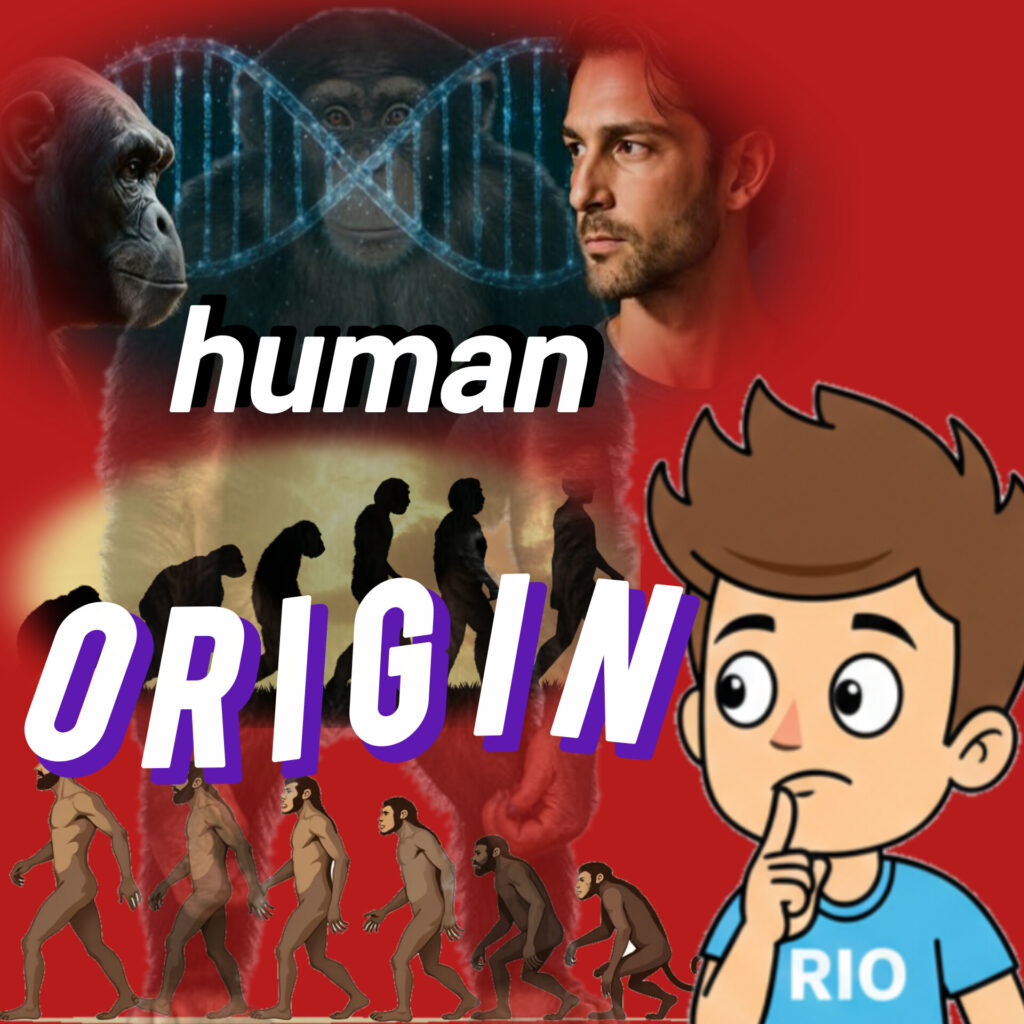
Have you ever wondered how we humans came to be on this Earth? Did we always look like this, or were our ancestors different? The scientific theory of evolution tells us that today’s humans are the result of millions of years of change. In this article, we will delve into the journey from stardust to today’s intelligent human (Homo sapiens).
Our Closest Relatives: The Great Apes
To understand the story of human evolution, we need to look at the animals alive today. Chimpanzees, gorillas, and orangutans are considered our closest relatives. Scientists have found that humans and chimpanzees share 99% of their DNA. Our blood groups and the way we experience emotions are also quite similar to theirs. This is why they are called ‘Great Apes’.
The Disappearance of the Tail and Walking on Two Legs
Approximately 25 million years ago, a major change occurred in some of our ancestors—their tails began to disappear. Research suggests that this happened due to a mutation in a gene called ‘TBXT’.
As our ancestors descended from the trees and began living on the plains, they learned to walk on two legs. Walking upright freed our hands, enabling us to grasp objects and make tools. The fossil known as ‘Lucy’ is the greatest evidence that our ancestors were walking on two legs millions of years ago.
The Rise of the ‘Homo’ Species and the Magic of Tools
The most significant turning point in human evolution came with the emergence of the ‘Homo’ category of organisms:
• Homo habilis: These are called the ‘Handy Man’. These were the first ancestors who learned to shape stones to make tools.
• Homo erectus: These were the first ‘working men’. They were the first to learn to use fire. Cooking food over fire gave them more energy, which led to an increase in their brain size. They were the first ancestors to migrate out of Africa and reach Asia and Europe.
• Neanderthals: These were our closest ‘cousins’. They were very intelligent, lived in caves, and buried their dead. Although they became extinct 40,000 years ago, a small percentage of their DNA is still found in many humans today.
Homo sapiens: The intelligent human of today
We, Homo sapiens, emerged in Africa approximately 300,000 years ago. Our brains were much larger (1350 cc) than those of previous species. This larger brain gave humans the power to ‘imagine’ and create ‘art’. It is this intelligence that allowed us to develop language, create societies, and now rule the entire world.
Are humans still evolving?
Evolution never stops. It is a slow process that becomes visible over thousands of years. Here are some modern examples:
• Skin color: Human skin color has changed according to sunlight exposure. Those living near the equator developed darker skin to protect themselves from UV rays.
• Ability to digest milk: In ancient times, humans could not digest milk after childhood. But as we started animal husbandry, our bodies developed the ability to digest milk (lactose tolerance).
• Height and build: Due to better nutrition, the average height of humans has also increased in the last 100 years.
We are all made of ‘stardust’
If we trace this chain of evolution further back, we find that life began in water with a single cell. Our DNA is 73% similar to that of a zebrafish. And if we go back to the beginning of the universe, we find that our entire body is made of the same elements that were once released from the explosion of stars. That’s why it is said that “we are all made of stardust.”
Rio Opinion
This story of human evolution teaches us that we are a small but very special part of nature. This journey from a single cell to reaching for the stars is an amazing example of struggle and adaptation. It has taken millions of years to reach where we are today, so we must use our intelligence to protect this planet and its biodiversity.