

Are we humans alone in the infinite depths of the universe? Do aliens live on some other planet far away? These questions have been swirling in the human mind for centuries. To find the answer to this question and to make contact with aliens, NASA took a bold step in 1977 that made history. This mission was called the Voyager Mission.
In this article, we will learn in detail about the exciting journey of Voyager 1 and Voyager 2, the planets they discovered, and the secret messages we sent into space.
The Beginning of the Voyager Mission and a Unique Coincidence
The story of the Voyager mission began in 1965 when a NASA engineer noticed something very special. He observed that in the late 1970s, the four largest planets in our solar system—Jupiter, Saturn, Uranus, and Neptune—were going to align in a straight line, an event that happens only once every 175 years.
To take advantage of this rare alignment, NASA decided to use the ‘gravity assist’ technique. This meant that a spacecraft would be sent past these planets so that their gravitational pull could be used to increase the spacecraft’s speed. This would make it possible to reach the outer reaches of the solar system with less fuel and in less time. With this plan, Voyager 1 and Voyager 2 were launched in 1977.
Voyager 1 and 2: The farthest human-made objects
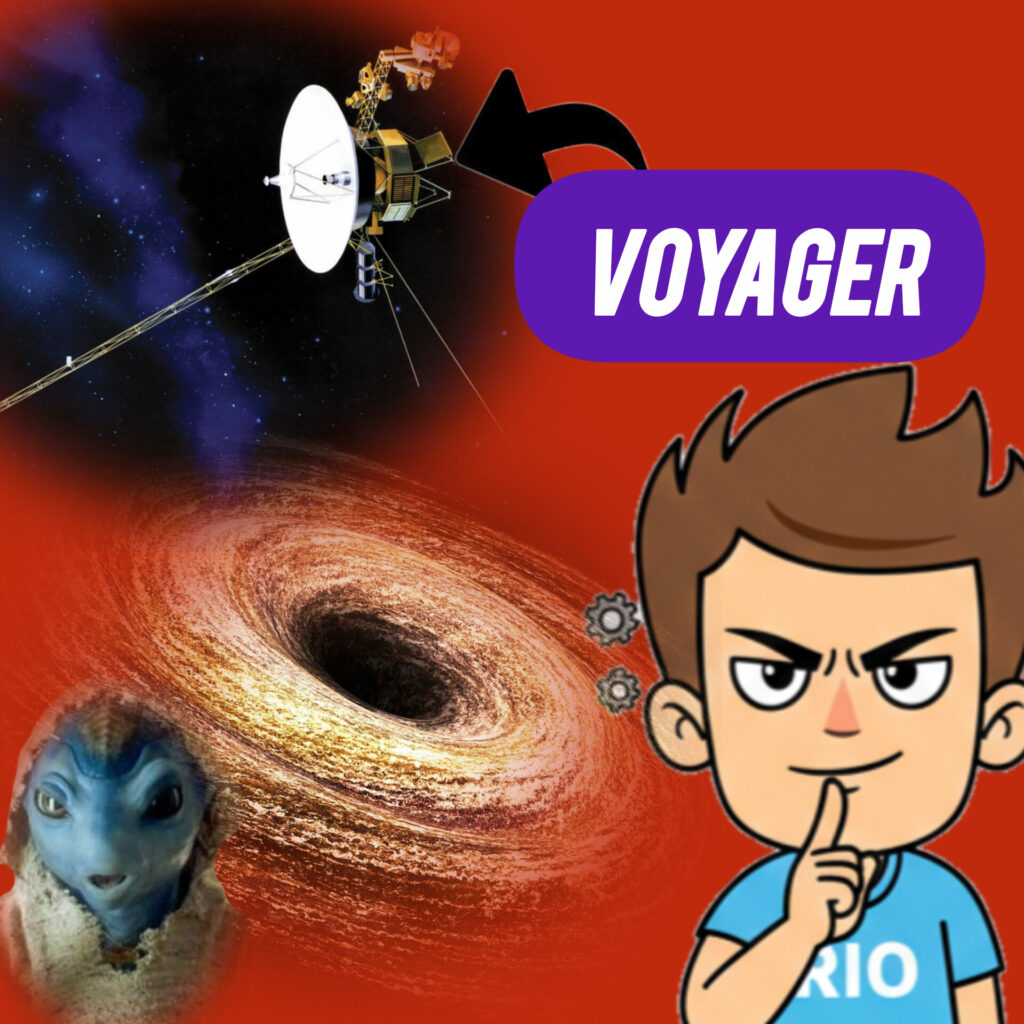
Voyager 1 is now approximately 25 billion kilometers away from Earth. It is the first human-made object to cross the boundary of our solar system (Heliosphere) and reach ‘interstellar space’ (the space between stars). The most remarkable feature of these spacecraft is that they don’t have any solar panels. So far from the sun, sunlight is practically nonexistent, so they are powered by electricity generated from the radioactive decay of plutonium.
Major discoveries of this mission:
• Jupiter: Voyager sent back the first images of Jupiter’s rings. It also discovered active volcanoes on its moon Io.
• Saturn: Evidence of liquid methane and water was found on its moon Titan, suggesting the possibility of life.
• Uranus and Neptune: Voyager 2 is the only spacecraft in the world to have flown so close to Uranus and Neptune.
The Golden Record: A “time capsule” for aliens
The most interesting part of this mission is the Golden Record placed on these spacecraft. It’s a 12-inch gold-plated copper disc, a kind of gramophone record. NASA sent it with the hope that if an alien civilization ever finds it, they can learn about our Earth and humanity.
What does this record contain?
• Sounds of Earth: It includes recordings of rain, thunder, birdsong, and even the sound of a mother kissing her child.
• Greetings: Human greetings in 55 different languages of the world have been included.
• Music: It contains music from various cultures around the world, including an Indian classical song – “Jaat Kahan Ho” sung by Surshri Kesarbai Kerkar.
• Images: It contains 115 digital images depicting the human body, DNA, mathematical formulas, and historical buildings like the Taj Mahal.
Surprisingly, these images only show the good and positive aspects of humanity. They don’t include any pictures of war, poverty, or crime.
‘Pale Blue Dot’: Our Place in the Universe
On February 14, 1990, when Voyager 1 was 6 billion kilometers from Earth, at the request of the renowned scientist Carl Sagan, it turned back and took one last picture of our planet. This image is known as the “Pale Blue Dot.” In it, our vast Earth appears as a tiny blue speck, almost lost in a single ray of sunlight. This picture reminds us how small we are in this immense universe and that we must take care of our little world.
The Future of Voyager: Will it Ever Stop?
After nearly 47 years of continuous travel, Voyager’s batteries and power supply are slowly running out. Scientists estimate that its contact with Earth will be permanently lost by 2025 or 2026.
But even if the machine stops working, it will continue to drift through the silence of space for millions of years. Even if we lose contact, the “Golden Record” inside will remain safe. This record will be the only witness to our civilization in the distant future, perhaps one day falling into the hands of an alien who will learn that life once existed on a planet called “Earth.”
Rio Opinion
The Voyager mission is not just a scientific achievement; it is a symbol of humanity’s never-ending curiosity. It teaches us that even though we live on a tiny blue dot, our thoughts and dreams have the courage to encompass the entire universe.