
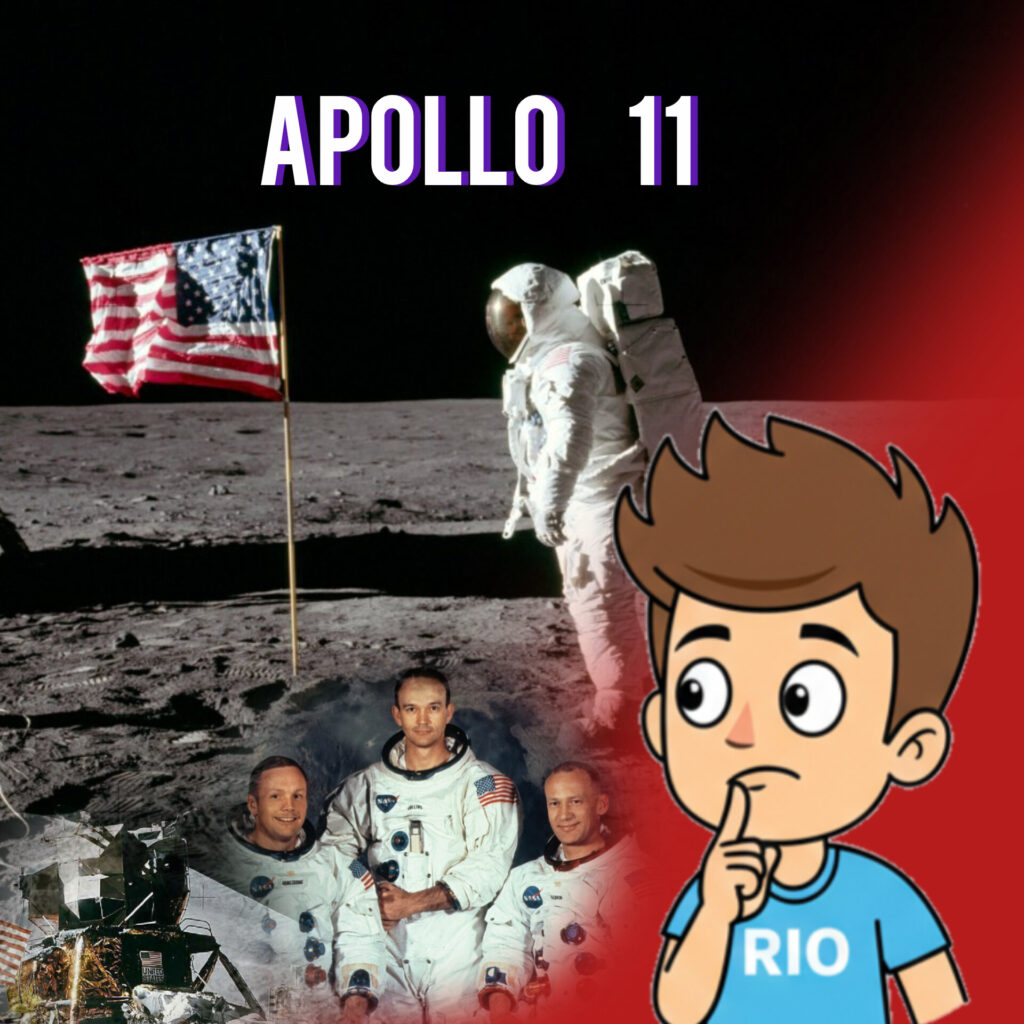
July 20, 1969, is considered one of the most significant days in human history. On this day, the world witnessed Neil Armstrong taking his first steps on the lunar surface, creating a new chapter in history. But for the past 50 years, a debate has raged on—was this mission real, or was it a grand hoax orchestrated by the United States?
In this article, we will explore the complete story of the Apollo 11 mission, the science behind it, and the truth behind all the conspiracy theories that claim it was a lie.
The Beginning of the Mission: The Space Race and the Cold War
The foundation of the Apollo 11 mission rested more on politics and the Cold War than on science. At that time, the United States and the Soviet Union (Russia) were locked in a fierce competition to prove their superiority.
In 1957, the Soviet Union gained an advantage by launching the Sputnik satellite. Following this, in 1961, Yuri Gagarin became the first human in space. The United States was lagging behind, so President John F. Kennedy promised the world that America would send a man to the moon before the end of the decade. To fulfill this promise, NASA spent billions of dollars and, with the help of thousands of scientists, developed the Apollo mission.
Apollo 11: The Exciting Journey from Earth to the Moon
On July 16, 1969, the Saturn V rocket launched with three astronauts—Neil Armstrong, Buzz Aldrin, and Michael Collins.
• Reaching the Moon: After traveling approximately 400,000 kilometers, the spacecraft reached the moon’s orbit.
• Separation into Two Parts: Here, the spacecraft separated into two parts. The main module, ‘Columbia’ (carrying Michael Collins), remained in orbit around the Moon, while the lunar module named ‘Eagle’ carried Neil Armstrong and Buzz Aldrin towards the lunar surface.
• Dangerous Landing: During the landing, the computer began to overload, and alarms sounded. Fuel was also running very low. But Neil Armstrong took manual control and landed safely in a secure location on the Moon, the ‘Sea of Tranquility’.
Time Spent on the Moon
Neil Armstrong became the first human to set foot on the Moon. His words are still remembered today: “That’s one small step for man, one giant leap for mankind.”
He and Buzz Aldrin spent about two and a half hours on the Moon. During this time, they:
• Collected samples of lunar soil and rocks (approximately 23 kg).
• Planted the American flag.
• Installed several scientific instruments, one of which is still used today to measure the distance from Earth to the Moon using laser beams.
Conspiracy Theories: Was it all a film?
Many people claim, based on certain arguments, that this mission was fake. Let’s examine the truth behind these claims:
1. How did the flag wave without wind?
It is claimed that since there is no air on the Moon, how could the flag be seen waving?
The truth: NASA engineers knew there was no air, so a horizontal rod was attached to the top of the flag to keep it extended. The ‘waves’ seen in the flag are actually folds in the fabric because the astronauts did not fully extend the rod.
2. Why were there no stars in the sky?
In the pictures, the sky is black, but not a single star is visible.
The truth: The landing on the Moon took place during daylight hours (lunar day). According to the rules of photography, when you photograph something very bright (like a white spacesuit), the less brightly lit objects in the background (the stars) don’t show up in the camera.
3. Why were the shadows pointing in different directions?
It is said that the sun is the only source of light on the moon, so the shadows should have been parallel.
The truth: The moon’s surface is uneven. In addition, the lunar soil itself reflects a lot of light, acting as a secondary light source. This is why the shadows appear distorted.
A pen saved the day
A major problem arose during the return journey. While exiting, a small circuit breaker switch that started the engine had accidentally broken. Without it, the engine couldn’t start, and both astronauts could have been stranded on the moon forever.
That’s when Buzz Aldrin showed his ingenuity. He used his ballpoint pen to replace the broken switch and complete the circuit. The engine started, and they were able to return safely.
Why haven’t we gone back to the moon in 50 years?
This question is often asked. The biggest reasons are “money” and “necessity.”
In the 1960s, the US allocated a large portion of its GDP (about 4%) to NASA. Once they reached the moon and won the space race, public and political interest waned. Furthermore, the Vietnam War also impacted the US economy.
However, NASA is now preparing to send humans back to the moon through its Artemis program.
Rio Opinion
The Apollo 11 moon landing was not a hoax, but a great example of science and human courage. The biggest proof of this is that Russia (the Soviet Union), which was America’s enemy, also acknowledged the landing as real. If this were a lie, Russia would have been the first to tell the world.
Many of the technologies we use today—whether computer chips or wireless headphones—were invented to meet the needs of this very mission.