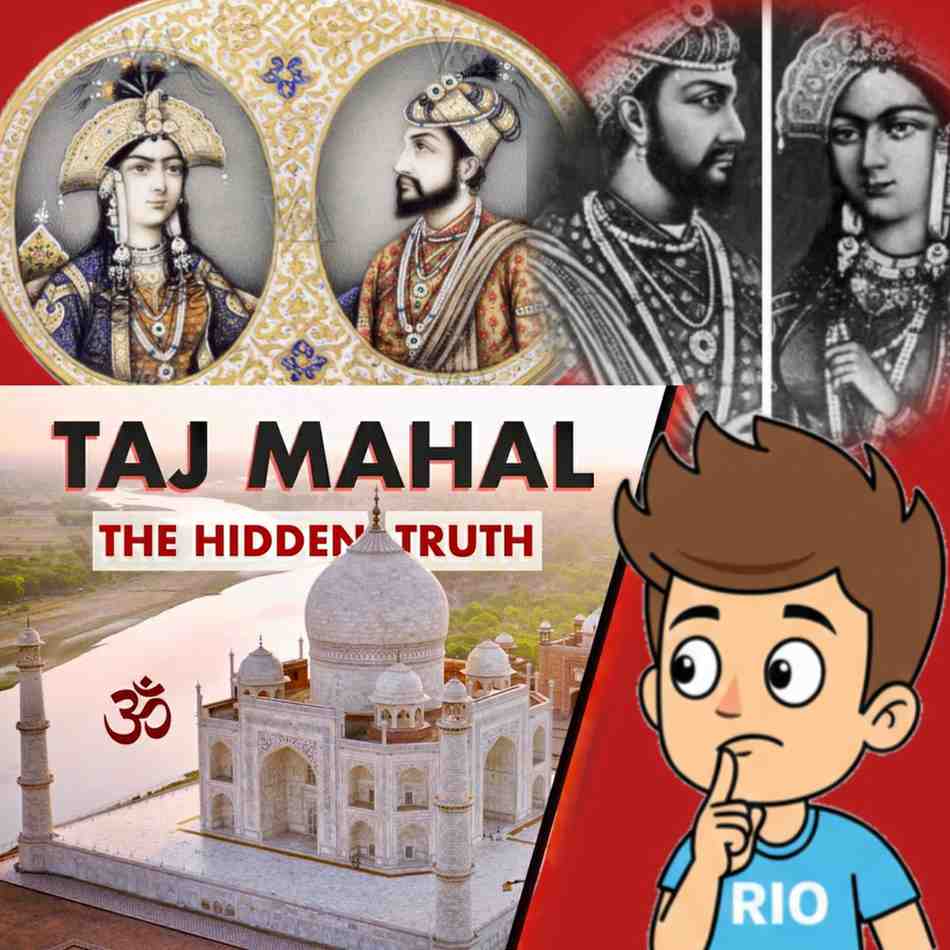
The Taj Mahal is not just a building of stone and marble, but an icon of India and one of the Seven Wonders of the World. It is often the subject of various claims on social media and in discussions. Some call it ‘Tejo Mahalaya,’ while others claim there are idols in its 22 closed rooms. In this detailed article, we will analyze the truth behind all these claims and examine the evidence available in history books and with the Archaeological Survey of India (ASI).
Shah Jahan and Mumtaz: A Historical Love Story
The foundation of the Taj Mahal’s construction began with a tragedy. Shah Jahan (Khusrau) and Mumtaz (Arjumand Banu Begum) were married in 1612. Mumtaz was not only Shah Jahan’s wife but also his most trusted political advisor.
On June 17, 1631, Mumtaz died in Burhanpur while giving birth to her 14th child. After her death, Shah Jahan was so deeply saddened that, according to contemporary historians, his hair turned white overnight. To fulfill Mumtaz’s last wish and immortalize her memory, Shah Jahan resolved to build a structure that would be unparalleled in the world.
Who was the Real Owner of the Land?
It is often claimed that Shah Jahan forcibly seized the land from Raja Jai Singh. However, historical documents tell a different story:
• The Haveli Transaction: Where the Taj Mahal stands today, there was previously a large mansion (haveli) belonging to Raja Jai Singh.
• Proof of Transaction: Raja Jai Singh was very close to the Mughals. He offered to donate the land, but instead of accepting it for free, Shah Jahan gave Raja Jai Singh four other large mansions in exchange.
• Documents: The official ‘decree’ of this transaction is still preserved today in the City Palace Museum in Jaipur, proving that the land was acquired legally.
The ‘Tejo Mahalaya’ Theory and P.N. Oak’s Claim
The biggest source of the theory that the Taj Mahal is ‘Tejo Mahalaya’ (a Shiva temple) is the book by Purushottam Nagesh Oak (P.N. Oak). He claimed that the Mughals converted a Hindu temple into a tomb.
P.N. Oak’s claims examined against the facts:
• Linguistic Argument: Oak argued that ‘Vatican’ is derived from the Sanskrit word ‘Vatika’ and that ‘Taj Mahal’ is actually ‘Tejo Mahalaya’. Experts have dismissed this as speculative, stating that history cannot be rewritten based on linguistic arguments without evidence.
• Contradictory Claims: Oak initially claimed that the temple was built in 1155, but later changed the date to 1212. Historians argue that no brick building from the 13th century could have survived in such good condition in the climate of North India.
• Supreme Court’s Stance: In 2000, when P.N. Oak filed a petition to declare the Taj Mahal a temple, the Supreme Court dismissed it, calling it ‘misleading’.
What is the mystery of the 22 locked rooms?
There are 22 rooms built beneath the platform of the Taj Mahal, and rumors have circulated that idols of deities or temple relics are hidden there.
• ASI’s clarification: According to the Archaeological Survey of India (ASI), these are not ‘secret rooms’ but a long corridor.
• Reason for the structure: Building basements was a common architectural practice in Mughal-era buildings (such as Humayun’s Tomb or Safdarjung’s Tomb). This was done to support the heavy weight of the structure.
• Photographic evidence: Recently, after a petition in the Allahabad High Court, the ASI released photographs of the inside of these rooms. The pictures clearly show only brick and stone walls and ongoing repair work. They are kept closed to tourists to prevent stress on the building’s structure and for security reasons.
The story of cutting off hands: Truth or falsehood?
We have heard since childhood that the hands of the 20,000 laborers who built the Taj Mahal were cut off. This story is completely false and baseless. The reasons behind this are as follows:
• The laborers’ next work: After the completion of the Taj Mahal, the same laborers built the Red Fort and Jama Masjid in Delhi. If their hands had been cut off, these buildings would never have been built.
• The existence of Tajganj: Shah Jahan established a settlement called ‘Tajganj’ near the Taj Mahal for the laborers to live in, where the descendants of those artisans still live today.
• No mention in history: Several foreign travelers (such as Bernier and Tavernier) visited India during Shah Jahan’s reign. They mentioned even minor events in their books, but there is no mention of such a great act of cruelty anywhere.
Architecture and construction materials
The construction of the Taj Mahal was a collaborative effort not only from India but from all over the world:
• White marble: Brought from Makrana, Rajasthan.
• Precious Stones: Jade and crystal were imported from China, turquoise from Tibet, and sapphires from Sri Lanka.
• Technique: The ‘Pietra Dura’ technique was used for the floral inlay work on the stones, making it one of the most beautiful buildings in the world.
Rio Opinion
The controversies surrounding the Taj Mahal are often political or emotional, but scientific and historical evidence clearly indicates that it is a tomb built by Shah Jahan. The Archaeological Survey of India (ASI) and the Government of India have repeatedly clarified in court that there is no evidence to support the claim that it was a temple.
The Taj Mahal is part of India’s shared heritage. It gives us an opportunity to be proud that our country possesses such craftsmanship, which attracts visitors from all over the world. It is wise to rely on facts rather than rumors.