
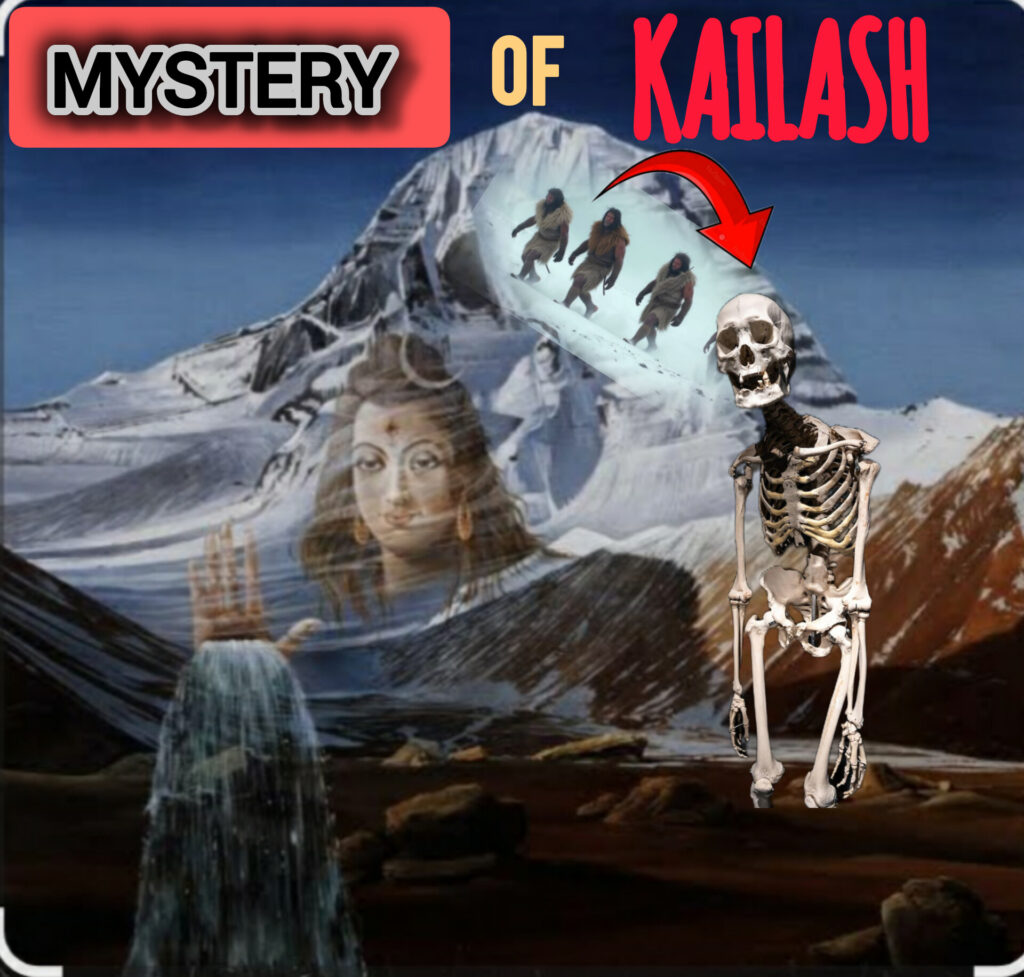
MYSTERY of Kailash
There are many places in the world known for their mysteries and religious importance, but Mount Kailash stands above them all. Located in the Himalayan region of Tibet, this mountain is not just a peak of rock and snow—it is the spiritual center of faith for millions of people.
While Mount Everest, the highest mountain in the world, has been climbed by thousands of adventurers, Mount Kailash remains untouched. No one has ever stood on its summit. Why is that so? Is it because of some divine miracle, or are there strong scientific and practical reasons behind it? In this article, we explore every important aspect related to the mystery of Mount Kailash.
Religious Significance of Mount Kailash
Mount Kailash is considered sacred by four major religions: Hinduism, Buddhism, Jainism, and Bon.
Hinduism:
In Hindu beliefs, Mount Kailash is the abode of Lord Shiva and Goddess Parvati. Ancient scriptures describe it as the center of the universe, also known as the Axis Mundi.
Buddhism:
Buddhists believe that Kailash is the home of Demchok, a deity symbolizing supreme bliss and enlightenment.
Jainism:
According to Jain traditions, the first Tirthankara, Rishabhdev, attained liberation (moksha) at this very place.
Bon Religion:
Bon, the ancient spiritual tradition of Tibet, considers Mount Kailash the meeting point of heaven and earth.
For thousands of years, devotees have been performing parikrama (circumambulation) of the mountain. However, their faith prevents them from ever stepping on the mountain itself.
Does Time Move Faster Near Mount Kailash? (The Myth of Time Dilation)
A popular claim circulating on social media suggests that time behaves differently around Mount Kailash. According to this belief, if a person stays near the mountain for 12 hours, their hair and nails grow as much as they normally would in two weeks.
The Russian Doctor’s Claim:
This theory became popular after a 1999 expedition by Russian doctor Ernst Muldashev, who claimed that the area felt like a “time machine.”
Scientific Reality:
From a scientific perspective, Einstein’s Theory of Relativity states that time dilation occurs only under extreme gravity or near the speed of light. No magnetic or gravitational anomaly has ever been recorded around Mount Kailash that could alter time.
In reality, the effects people experience are mostly due to high altitude, low oxygen levels, and physical exhaustion, which can affect perception and bodily sensations.
A Pyramid-Like Shape: Nature or Human Design?
Another fascinating feature of Mount Kailash is its pyramid-like shape. The four faces of the mountain align almost perfectly with the north, south, east, and west directions.
Geological Explanation:
Some believe the mountain was artificially constructed, but geologists explain that this shape is the result of glacial erosion over millions of years. Continuous ice movement carved the rock into a symmetrical structure.
A similar natural example is Europe’s Matterhorn Mountain, which also has a pyramid-like form.
The Mystery of Mansarovar and Rakshas Tal
Near Mount Kailash lie two large lakes—Lake Mansarovar and Lake Rakshas Tal. Despite being only 2–3 kilometers apart, their nature is completely opposite.
Lake Mansarovar (Freshwater):
This lake contains fresh water and is considered sacred. It is believed to be associated with divine energies.
Lake Rakshas Tal (Saltwater):
The water here is salty, and almost no aquatic life exists in it.
Scientific Reason:
Rakshas Tal is an endorheic lake, meaning it has no outlet. As water evaporates, salt remains, making it saline. Mansarovar, on the other hand, has natural water flow, which keeps it fresh.
Why Has No One Ever Climbed Mount Kailash?
People often wonder why Mount Kailash has never been climbed when Everest has been conquered many times. The answer lies in two main reasons:
Religious Respect:
In 1985, legendary mountaineer Reinhold Messner was offered permission by the Chinese government to climb Mount Kailash. He refused, saying, “We should not trample the home of the gods under our boots.”
Legal Ban:
In 2001, a Spanish expedition attempted to climb the mountain, but it faced global protests. Following this, the Chinese government imposed a permanent ban on climbing Mount Kailash. Today, attempting to climb it is a legal offense.
Conclusion: Respect Over Conquest
Mount Kailash teaches humanity an important lesson—that not everything is meant to be conquered. Humans have reached the Moon and sent missions to Mars, yet Mount Kailash remains untouched.
It stands as a reminder of humility, faith, and respect for nature. More than just a geological structure, Mount Kailash represents centuries-old spiritual beliefs and the deep connection between humans and the divine.
Mount Kailash: A Center of Mysterious Energy
One of the most fascinating things about Mount Kailash is the strange sense of peace and energy that people experience there. Many pilgrims who have visited the region say that as you come closer to the mountain, meditation begins to happen naturally, without any effort. People often claim that the air itself carries a unique resonance, which some associate with the sound of “Om” or the beat of a damru. For believers, this is not just a story but a deeply personal and powerful experience.
The region has extremely low oxygen levels and intense cold, conditions that can cause the human mind to function differently. Perhaps this is why many people feel they are able to understand spiritual depths more clearly in this place. Mount Kailash repeatedly reminds us that some creations of nature are destined to remain beyond the full understanding of human beings.
click here’s for more information https://youtu.be/OX5vqtiZQ2s?si=FgoPKtLXxP-6HOKP


Nice