There are many gems in the world that have changed the course of history, but none are quite like the Kohinoor. It is considered the world’s most famous and controversial diamond. The story of this diamond is not just one of glitter and glamour, but also of deceit, conquest, death, and a curse that brought down great empires. Today, in this article, we will understand the journey of the Kohinoor, which began in the mines of India and ended up in the British Crown Jewels in London.
The Birth and Early History of the Kohinoor
The word Kohinoor means “Mountain of Light” in Persian. There are several beliefs surrounding its origin. Some consider it to be the ‘Syamantaka’ gem from the time of Lord Krishna, but the most historically accurate fact is that this diamond was mined from the Kollur mines (Golconda) in Andhra Pradesh, India.
Until the 18th century, India was the only country in the world where diamonds were found. There is no written record of when the Kohinoor was discovered, but it is believed that the diamond first appeared in historical records between the 13th and 14th centuries. Initially, it was with the Kakatiya dynasty, after which it passed to the Delhi Sultanate and then to the Mughal Empire.
The Mughal Period and the Peacock Throne
The Mughal emperor Babur mentioned a diamond in his autobiography, Baburnama (1526), whose value was so immense that it could cover half the world’s expenses for a day. But the Kohinoor gained its true recognition when Shah Jahan commissioned his famous ‘Peacock Throne’ (Takht-e-Taus).
This throne cost four times more than the Taj Mahal to build. It was studded with many precious gems, but the greatest pride of place was given to the Kohinoor diamond and the Timur Ruby. Interestingly, the Mughals preferred red rubies to diamonds, but the Koh-i-Noor’s unique brilliance always set it apart.
Nadir Shah and the Naming of the Koh-i-Noor
In 1739, Nadir Shah, the invader from Persia (Iran), attacked Delhi. He defeated the Mughals and plundered immense wealth. It is said that he needed 700 elephants, 4,000 camels, and 12,000 horses to carry the treasure back to his country.
According to a legend, Nadir Shah learned that the Mughal emperor Muhammad Shah had hidden the diamond in his turban. He cleverly orchestrated a ceremony of exchanging turbans, and when the diamond fell out, its dazzling brilliance made Nadir Shah exclaim, “Koh-i-Noor!” Since then, it has been known as the Koh-i-Noor.
The Curse of the Kohinoor
An old belief is associated with the Kohinoor diamond: “Whoever owns this diamond will rule the world, but misfortune and sorrow will also befall them.” This diamond has been considered unlucky for men.
History shows that every male ruler who wore or possessed it met a tragic end:
• Nadir Shah: He was murdered by his own bodyguards.
• Durrani Empire: Bloody conflicts erupted among the descendants of Ahmad Shah Abdali, and several rulers were blinded.
• Sikh Empire: Maharaja Ranjit Singh acquired it from Shah Shuja, the ruler of Afghanistan. After Ranjit Singh’s death, the Sikh Empire rapidly disintegrated, and his youngest son, Duleep Singh, was separated from his mother.
The Sikh Empire and Maharaja Duleep Singh
After the death of Maharaja Ranjit Singh, Punjab became vulnerable. In 1849, when the British (East India Company) defeated the Sikhs, they forced the 11-year-old Maharaja Duleep Singh to sign a treaty (Treaty of Lahore). Under this treaty, the Kohinoor was to be handed over to Queen Victoria of Britain.
Duleep Singh was sent to England and converted to Christianity. He lived his entire life in a kind of exile and sorrow. He died in poverty and loneliness in a modest hotel in Paris.
The Kohinoor in London: Queen Victoria and the Diamond’s Recutting
When the Kohinoor first arrived in London and was put on display for the public in 1851, people were disappointed. They thought it was just a piece of glass because its brilliance wasn’t what it is today.
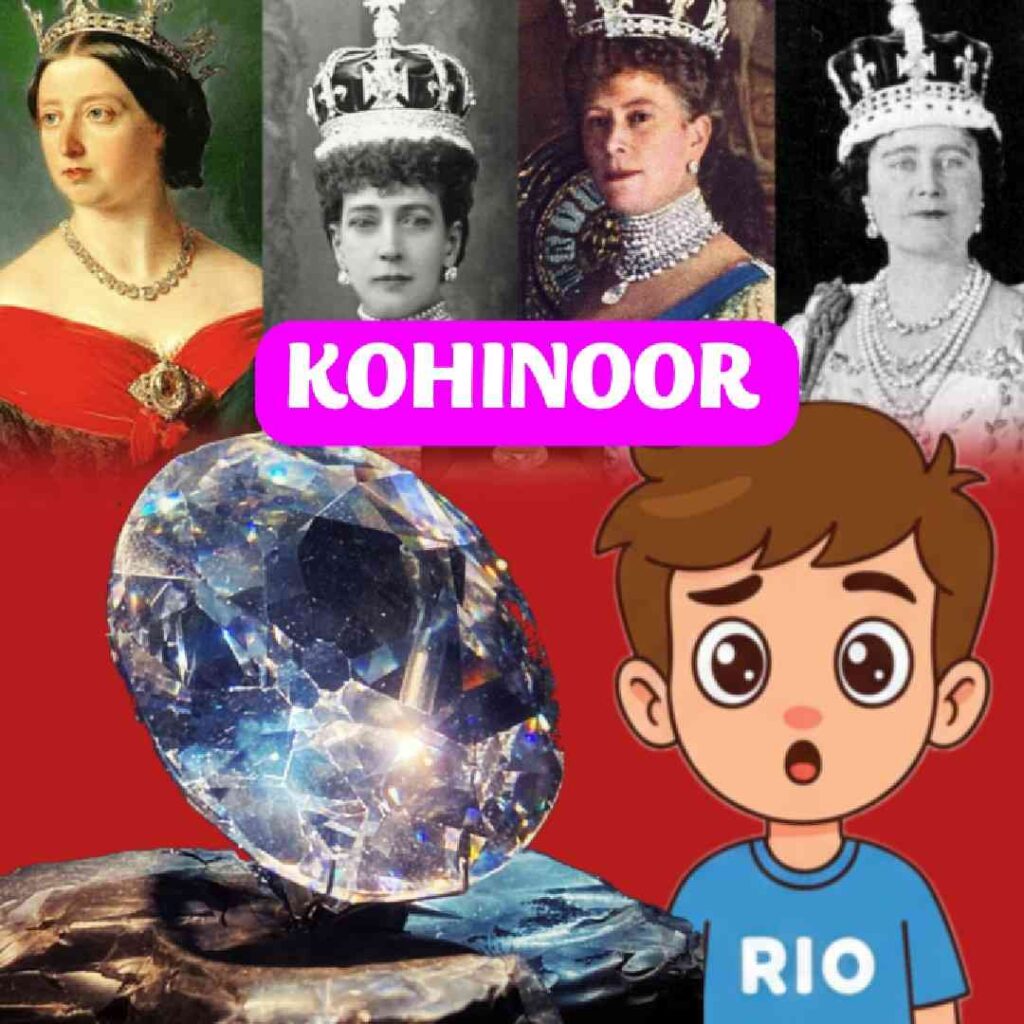
Subsequently, Queen Victoria’s husband, Prince Albert, decided to have the diamond recut and polished. This process reduced the Kohinoor’s weight by 40%. Initially, it weighed 186 carats, but after being cut, it was reduced to just 105.6 carats. Today, it is about the size of a small egg.
Why is it only worn by women?
Due to fears of a curse and historical events, the British royal family decided that the Koh-i-Noor would never be worn by a man (king). It would always be worn by a woman (queen). After Queen Victoria, it became part of the crowns of Queen Alexandra, Queen Mary, and then Queen Elizabeth (the Queen Mother). Even today, it is kept under tight security in the Tower of London.
Can India get it back?
India, Pakistan, Afghanistan, and even Iran claim ownership of the Koh-i-Noor. There have been several demands in India for its return, but there are some legal hurdles:
• UNESCO Convention (1970): This law states that this rule does not apply to items that went to other countries as cultural heritage before 1970.
• British Government’s argument: The British claim that the diamond was not stolen but was given to them under a legal treaty (Treaty of Lahore).
Quick Facts:
• Original location: Kollur mine, Andhra Pradesh.
• Current weight: 105.6 carats.
• Location: Jewel House, Tower of London.
• Named by: Nadir Shah in 1739.
• Last Indian owner: Maharaja Duleep Singh.
Rio Opinion
The Koh-i-Noor is not just a precious stone, but a silent witness to history. It has seen empires rise and fall. Although it is currently in London, for every Indian, it remains a symbol of the glory that was once India’s identity. Whether it is returned or remains where it is, the story of the Koh-i-Noor will always fascinate people.